
- July 21, 2026
- Posted by: admin
- Category: Employment Law

Key Takeaways
- ESA vs. Common Law: Ontario employees are often entitled to significantly more than the bare minimums set out in the Employment Standards Act. Common law reasonable notice can extend up to 24 months depending on factors like age, length of service, and the nature of the position.
- Termination Pay vs. Severance Pay: Under Ontario law, termination pay (or notice) and statutory severance pay are distinct legal concepts with different qualification thresholds, though they are frequently bundled together in a single package.
- The “Payment in Lieu” Option: Employers frequently choose to terminate an employment relationship immediately by providing a payment in lieu of notice rather than requiring the employee to work through a notice period.
- Do Not Sign Immediately: Severance packages and layoff offers usually come with strict deadlines, but signing prematurely can result in forfeiting tens of thousands of dollars in common law entitlements.
- Legal Reviews Prevent Underpayment: Consulting a dedicated employment law firm like Nadi Law ensures that your package is thoroughly evaluated against the latest 2026 legal frameworks and judicial precedents.
Navigating a job loss is an incredibly stressful experience that leaves many workers feeling vulnerable and uncertain about their financial future. When an employer terminates your employment, they are legally required to provide compensation to help sustain you while you look for alternative work. However, the specific amount of money you are owed depends on a complex interplay between provincial legislation and Canadian common law.
Many workers mistakenly believe that the initial offer presented by their employer represents the maximum amount they can receive. In reality, initial packages are often structured around legal minimums rather than your true legal value. Understanding your Severance Entitlement Ontario employees may be entitled to is the first step toward ensuring you receive a fair transition package that reflects your hard work and dedication. If you have questions about your rights after a dismissal, an employment lawyer Whitby can review your situation and explain your legal options.
Knowing your Severance Entitlement Ontario rights can make the difference between accepting the ESA minimums and receiving the significantly higher compensation available under common law.
Understanding Severance Entitlement Ontario
The phrase severance entitlement Ontario refers to the compensation an employee may receive after being terminated without cause.
There are generally two categories of termination compensation:
- Minimum entitlements under the Employment Standards Act (ESA)
- Potential additional compensation under common law
Many employees confuse these two systems. The ESA establishes minimum standards that employers must meet. However, unless an enforceable employment contract limits severance to ESA minimums, employees may be entitled to considerably more under common law.
This distinction is often the most important factor in determining the value of a termination package. If you are uncertain about your rights or whether your employer’s offer is fair, consulting an employment lawyer Whitby can help you better understand your legal options before making a decision.
What Is Ontario Termination Pay?
Ontario termination pay refers to compensation provided instead of working through the required notice period.
Rather than asking an employee to continue working after providing notice of termination, many employers choose to end employment immediately. When this happens, they typically provide payment that replaces the wages the employee would have earned during the notice period.
Termination pay generally includes:
- Regular wages
- Vacation pay where applicable
- Continued benefits during the notice period in certain situations
- Other employment-related compensation depending on the circumstances
It is important to distinguish termination pay from statutory severance pay because they are different legal concepts under Ontario law.
Decoding Ontario Termination Pay: The Two Direct Forms of Compensation
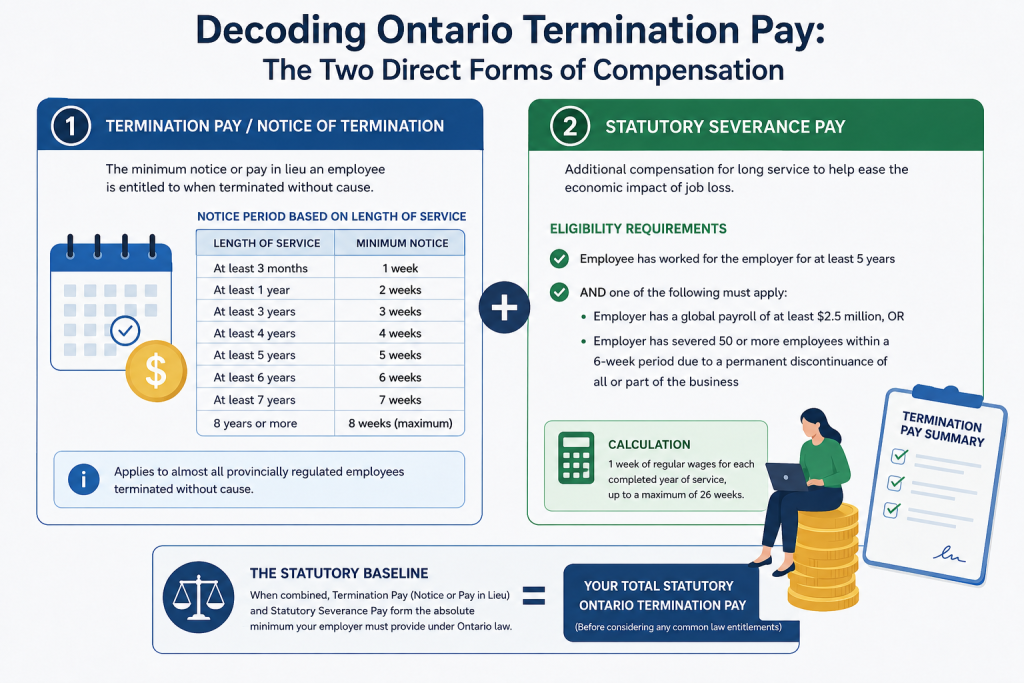
A layoff package in Ontario is made up of two separate statutory entitlements under the Employment Standards Act (ESA), with some employees also qualifying for additional common law entitlements.
The first component is termination pay or notice of termination. Employers must either provide written notice that employment is ending or offer payment in lieu of notice if they choose to end the employment immediately.
The statutory notice period is based on an employee’s length of continuous service. It starts at one week after three months of employment and increases gradually to a maximum of eight weeks for employees with eight or more years of service.
The second component is statutory severance pay, which is separate from termination pay. It is intended to recognize long-term service and help employees manage the financial impact of losing their job.
To qualify, an employee must generally have at least five years of service, and the employer must meet certain conditions, such as having a global payroll of at least $2.5 million or terminating 50 or more employees within a six-week period due to a business closure.
Statutory severance pay is calculated as one week of regular wages for each completed year of service, up to a maximum of 26 weeks. Together, termination pay and statutory severance pay represent the minimum entitlements under Ontario law. If you’re unsure whether your package is fair, consider speaking with an employment lawyer Vaughan.
Crucial Difference Between Statutory Minimums and Common Law Entitlements
Understanding the distinction between statutory minimums and common law entitlements is essential, as the difference can significantly affect the compensation an employee may receive after termination.
| Aspect | Statutory Minimums (Employment Standards Act) | Common Law Entitlements |
|---|---|---|
| Purpose | Establishes the minimum termination pay employers must provide to comply with provincial employment standards legislation. | Aims to provide reasonable financial support while an employee searches for comparable employment. |
| Legal Basis | Created through provincial employment legislation. | Developed through decades of court decisions and legal precedent across Canada. |
| Who Qualifies? | Applies to eligible employees covered by the Employment Standards Act. | Applies to most employees unless a valid and enforceable employment contract clearly limits entitlements to statutory minimums. |
| Compensation Amount | Limited to the minimum notice, termination pay, and severance (where applicable) required by law. | Often significantly higher than statutory minimums, depending on the employee’s circumstances. |
| How It Is Calculated | Based on fixed rules set out in employment standards legislation. | Determined individually by courts using established legal principles rather than a fixed formula. |
| Key Factors Considered | Primarily based on length of service and statutory requirements. | Courts consider the employee’s age, length of service, position or specialization, and the availability of similar employment. |
| Maximum Potential Recovery | Limited to the statutory minimums prescribed by legislation. | Can extend up to 24 months of compensation in appropriate cases, depending on the circumstances. |
| Typical Outcome | Provides only the minimum legal protection for employees. | May provide substantially greater compensation than the statutory minimums. |
Understanding Payment in Lieu of Notice and Working Notice
When an employer terminates an employee, they typically choose one of two approaches: working notice or payment in lieu of notice.
- Working Notice: The employee continues working until a specified end date while receiving their regular salary and benefits. Although legally permissible, this approach can create an uncomfortable and less productive work environment.
- Payment in Lieu of Notice: Instead of requiring the employee to work, the employer ends the employment immediately and provides compensation equivalent to what the employee would have earned during the notice period. This payment may be made as a lump sum or through salary continuance over time.
A proper payment in lieu of notice should cover the employee’s total compensation package, including:
- Base salary
- Health and insurance benefits
- Pension or retirement contributions
- Regular bonuses or commissions
- Car allowance and other contractual benefits
Ensuring all components of compensation are included helps employees receive the full value of their notice entitlement.
Real-World Case Examples: How Severance Entitlements Formulate
To demonstrate the massive financial discrepancy between statutory minimums and common law entitlements, let us examine two realistic scenarios that frequently occur in the Ontario corporate landscape.
Case Scenario 1: The Mid-Career Mid-Management Professional
A 45-year-old operations manager with 7 years of service is terminated without cause after a company restructuring.
- ESA entitlement: 7 weeks of termination pay.
- Statutory severance pay: Not eligible because the employer’s payroll is below the required threshold.
- Common law outcome: Without a valid termination clause, the employee may be entitled to 7–10 months of compensation, depending on factors such as age, experience, and job market conditions.
Case Scenario 2: The Long-Service Senior Executive
A 58-year-old senior vice president with 22 years of service is terminated without cause by a large employer.
- ESA entitlement: 8 weeks of termination pay plus 22 weeks of statutory severance pay.
- Common law outcome: Considering the employee’s age, seniority, long service, and limited executive opportunities, common law compensation could range from 18–22 months.
- Additional compensation: Common law may also include bonuses, benefits, and other forms of regular compensation, resulting in a significantly higher overall package than the statutory minimum.
Comprehensive Comparison: Statutory Minimums vs. Common Law Notice
The table below highlights the structural differences between these two legal systems, helping you visualize how an initial layoff package in Ontario can be evaluated.
| Legal Criteria | Employment Standards Act (ESA) Minimums | Common Law Reasonable Notice |
| Primary Source | Provincial legislation passed by the government. | Decades of binding judicial decisions and court precedents. |
| Maximum Cap | Maximum of 8 weeks notice + 26 weeks severance. | Generally capped at 24 months, with rare exceptions. |
| Key Factors Used | Strictly based on length of service and payroll size. | Age, length of service, character of job, and job market. |
| Compensation Base | Usually restricted to base salary and basic benefits. | Includes base salary, bonuses, commissions, and perks. |
| Contract Influence | Cannot be waived or altered by an employment contract. | Can be restricted only by a legally binding termination clause. |
| Mitigation Duty | No statutory obligation to look for a new job. | Legal duty to make reasonable efforts to find new work. |
Common Pitfalls and Employer Tactics to Avoid
When managing a corporate downsize, companies often deploy specific strategic measures to control their financial liabilities.
- High-Pressure Deadlines: Employers may impose short deadlines to encourage employees to sign severance agreements quickly. You are generally entitled to take time to review the offer and seek legal advice before signing.
- Accepting the First Offer Too Quickly: An initial severance package may only reflect statutory minimums rather than your potential common law entitlements. Reviewing the offer carefully can help you understand its true value.
- Misleading Working Notice Arrangements: Some employers combine a short period of working notice with a small lump-sum payment, which may still fall short of the compensation you could be entitled to under common law.
- Relying on Unenforceable Termination Clauses: Not all termination clauses are legally valid. If a clause fails to comply with the Employment Standards Act, it may be unenforceable, potentially increasing your entitlement.
- Signing Away Your Rights Without Review: Once you sign a release, you may lose the ability to pursue additional compensation. Having your severance package reviewed before signing can help protect your legal rights. Consulting employment lawyers Oshawa before accepting an offer can help ensure you understand the compensation you may be legally entitled to.
When to Seek Professional Guidance for Your Layoff Package
It is vital to recognize that you are under no legal obligation to sign a severance release on the day you are terminated.
1. Don’t Feel Pressured to Sign Immediately
You are not legally required to sign a severance agreement on the day of your termination. Take time to review the offer carefully before accepting it.
2. Your Compensation Package Is Complex
If your package includes stock options, deferred bonuses, commissions, or other incentive-based compensation, professional guidance can help determine its full value.
3. You Believe the Severance Offer Is Inadequate
If you think the compensation offered does not reflect your years of service or circumstances, a legal review can help assess your potential common law entitlements.
4. You Suspect Discrimination Played a Role
If your termination may be connected to age, disability, pregnancy, parental leave, or another protected ground, you could have additional legal rights under the Ontario Human Rights Code.
5. You Want to Ensure You Receive Everything You’re Entitled To
A professional review of your layoff package can help identify whether you are entitled to additional compensation, benefits, or damages before you sign a release.
Conclusion
Securing your full Severance Entitlement Ontario is about understanding the difference between statutory minimums and the significantly greater compensation that may be available under common law. Employers frequently structure initial offers to protect their own financial bottom line, hoping that departed workers will sign quickly without questioning the underlying calculations. Accepting a deficient package can have long-lasting negative effects on your financial stability as you look for your next professional opportunity.
Before you sign any release forms or accept a generic settlement offer, ensure your rights are fully protected. The experienced legal professionals at Nadi Law specialize in analyzing complex termination packages, uncovering hidden compensation elements, and aggressively pursuing the full common law notice you deserve. Contact Nadi Law today to schedule a comprehensive review of your termination documents and ensure you move forward into your next career chapter with financial security.
Frequently Asked Questions
1. Can my employer terminate me immediately without any advance warning?
Yes, an employer can legally terminate almost any employee at any time without advance warning, provided the termination is not based on discriminatory grounds. This action is known as termination without cause. However, to do this legally, the employer must provide immediate compensation in the form of a financial payment in lieu of notice Ontario regulations mandate, ensuring the worker is supported during their sudden transition.
2. What happens if I sign my severance release paper right away?
If you sign the release document immediately, you enter into a legally binding contract that officially releases your employer from any future financial claims. Even if you discover later that you were drastically underpaid or that your package failed to meet common law standards, it becomes exceptionally difficult to overturn a signed release unless you can prove extreme duress or unconscionability.
3. Does statutory severance apply if a company downsizes a small local office?
Statutory severance pay under the Employment Standards Act only applies if the individual has five or more years of service and the employer has a total payroll in Ontario of at least 2.5 million dollars, or if the employer terminates 50 or more workers within a six-week window due to a business closure. If these conditions are not met, you do not qualify for statutory severance, but you may still retain significant common law notice entitlements.