
- July 29, 2026
- Posted by: admin
- Category: Employment Law

Key Takeaways
- Ontario’s general minimum wage will increase to $17.95 per hour effective October 1, 2026.
- Different minimum wage rates apply to students, homeworkers, and hunting, fishing, and wilderness guides.
- Employers should review payroll systems, employee classifications, and wage records before the new rates take effect.
- Failure to comply with the Employment Standards Act (ESA) may result in Ministry of Labour investigations, wage repayment orders, and other penalties.
- Employees who are underpaid may have the right to recover unpaid wages under Ontario employment law.
- Minimum wage is only one part of the ESA and works alongside overtime pay, vacation pay, public holiday pay, and termination rights.
Many employers and employees ask the same question every year: what is minimum wage in Ontario? With Ontario announcing its latest wage adjustment for 2026, understanding the updated rates is essential for both businesses and workers. The province reviews minimum wage annually under the Employment Standards Act (ESA) to help ensure wages reflect changes in the cost of living while maintaining fair minimum employment standards.
Whether you operate a small business or work in Ontario, understanding the new wage rates can help prevent payroll errors, workplace disputes, and legal compliance issues. The updated rates affect thousands of employers across the province and influence other statutory entitlements, including overtime pay, vacation pay, and public holiday pay. If questions arise regarding wage compliance or employee rights, seeking guidance from an employment lawyer Vaughan can help clarify your legal obligations under Ontario employment law.
What Is Minimum Wage in Ontario?
Minimum wage is the lowest hourly wage an employer can legally pay most employees covered by Ontario’s Employment Standards Act, 2000 (ESA). Unless a specific exemption applies, every eligible employee must receive at least the applicable minimum wage for every hour worked.
The ESA establishes minimum workplace standards that protect employees while outlining the legal responsibilities of employers. These standards cover several aspects of the employment relationship, including:
- Minimum wage
- Hours of work
- Overtime pay
- Vacation pay and vacation time
- Public holiday pay
- Leaves of absence
- Termination and severance entitlements
- Payroll record-keeping requirements
Although the ESA sets the minimum legal standards, employers are always free to pay employees more than the prescribed minimum wage.
It is also important to understand that Ontario does not have a single minimum wage for every worker. Depending on an employee’s age, occupation, or working arrangement, different wage categories may apply. Employers should determine the correct classification before processing payroll to ensure compliance with provincial employment standards.
Maintaining accurate payroll records is equally important. Under the ESA, employers are generally required to keep records of hours worked, wage rates, deductions, overtime, vacation pay, and other employment information. Proper documentation helps demonstrate compliance if concerns arise during a Ministry of Labour inspection or investigation.
2026 Ontario Minimum Wage Rates
The Ontario government has confirmed that new minimum wage rates will take effect on October 1, 2026. The increase is based on Ontario’s annual Consumer Price Index (CPI) adjustment, ensuring wages continue to reflect inflation.
For most employees, the general minimum wage will increase from $17.60 per hour to $17.95 per hour, representing a 1.9% increase.
| Employee Category | Until Sept. 30, 2026 | Effective Oct. 1, 2026 |
|---|---|---|
| General Minimum Wage | $17.60/hour | $17.95/hour |
| Student Wage | $16.60/hour | $16.90/hour |
| Homeworker Wage | $19.35/hour | $19.70/hour |
| Hunting, Fishing & Wilderness Guides (Less than 5 hours/day) | $88.05/day | $89.75/day |
| Hunting, Fishing & Wilderness Guides (5 or more hours/day) | $176.15/day | $179.50/day |
The updated wage rates apply to most provincially regulated workplaces beginning October 1, 2026. Employers should update payroll systems before the effective date to ensure all eligible employees receive at least the applicable minimum wage from their first pay period following the increase.
Businesses should also review employment agreements and payroll policies that reference hourly wages to ensure they remain consistent with the new statutory rates.
Student Wage Ontario & Special Wage Categories
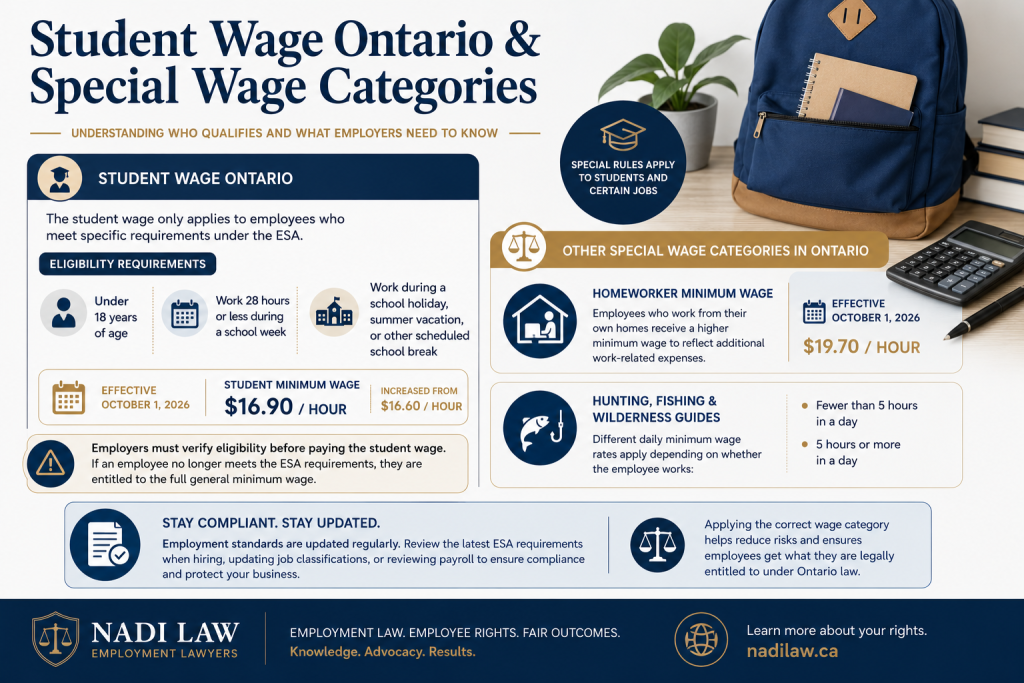
Another frequently asked question concerns student wage Ontario and who qualifies for this lower wage category.
Unlike the general minimum wage, the student wage only applies to employees who satisfy specific requirements under the Employment Standards Act. Generally, an employee may qualify if they:
- Are under 18 years of age;
- Work 28 hours or less during a school week; or
- Work during a school holiday, summer vacation, or other scheduled school break.
Effective October 1, 2026, the student minimum wage will increase from $16.60 per hour to $16.90 per hour.
Employers should carefully verify that each eligibility requirement is met before paying the student wage. One of the most common payroll mistakes is assuming every young employee qualifies for the reduced rate. If an employee no longer meets the ESA requirements, they may instead be entitled to receive the full general minimum wage.
Ontario also recognizes additional wage categories for certain occupations and work arrangements.
For example, homeworkers – employees who perform paid work from their own homes – receive a higher minimum wage because they often incur additional work-related expenses. Beginning October 1, 2026, the homeworker minimum wage will increase to $19.70 per hour.
Similarly, Ontario establishes separate daily minimum wage rates for hunting, fishing, and wilderness guides, with different rates depending on whether the employee works fewer than five hours or five hours or more in a day.
Because employment standards are periodically updated, employers should review the latest ESA requirements whenever hiring new employees, reviewing job classifications, or updating payroll systems. Correctly applying the appropriate wage category helps reduce compliance risks while ensuring employees receive the compensation they are legally entitled to receive under Ontario law.
Employer Responsibilities
The Ontario minimum wage increase requires employers to do more than simply raise hourly pay rates. Every employer covered by the Employment Standards Act (ESA) must ensure eligible employees receive at least the applicable minimum wage from October 1, 2026 onward.
To remain compliant, employers should:
- Update payroll software with the new wage rates before the effective date.
- Review employment agreements that reference hourly wages.
- Verify employee classifications, including eligibility for the student wage.
- Ensure overtime pay, vacation pay, and public holiday pay calculations reflect updated hourly rates.
- Maintain accurate payroll and timekeeping records.
- Train payroll and human resources staff on the latest ESA requirements.
Employers operating multiple locations or managing large workforces should consider conducting a payroll audit before the wage increase takes effect. Identifying and correcting payroll issues early can help reduce the risk of employee complaints, Ministry of Labour investigations, and costly compliance issues.
Common Payroll Mistakes
Many wage disputes arise from administrative errors rather than intentional underpayment. However, employers remain responsible for correcting payroll mistakes and paying any wages owed.
1. Failing to Update Wage Rates
A common mistake is continuing to pay the previous minimum wage after the new rates become effective. Even a short delay can result in unpaid wage claims and potential legal consequences.
2. Incorrectly Applying the Student Wage
Not every employee under the age of 18 qualifies for the student wage. Employers should confirm that the employee meets all ESA eligibility requirements before applying the reduced rate.
3. Payroll Software Errors
Outdated payroll systems or incorrect manual calculations can lead to employees being paid below the statutory minimum. Regular software updates and payroll reviews help minimize these risks.
4. Inaccurate Time Records
Failure to accurately record hours worked can make it difficult to verify whether employees have received the wages they are legally entitled to. Employers should maintain complete and accurate payroll records as required under the ESA.
5. Employee Misclassification
Using the wrong wage category may affect minimum wage compliance and other statutory entitlements, including overtime pay and vacation pay. Regular reviews of employee classifications help reduce compliance risks.
Employee Rights Under the Employment Standards Act
Employees covered by Ontario’s Employment Standards Act have the right to receive at least the applicable minimum wage for every hour worked. If an employee believes they have been paid less than the required amount, they may have legal options available depending on the circumstances.
Common wage-related concerns include:
- Being paid below the applicable minimum wage.
- Incorrect application of the student wage.
- Payroll errors resulting in unpaid wages.
- Missing overtime pay.
- Incorrect vacation pay calculations.
- Unpaid public holiday pay.
Employees should first raise the issue with their employer, as many payroll discrepancies are the result of administrative errors that can often be resolved quickly.
Where concerns remain unresolved, obtaining legal advice may help clarify available options. Wage disputes are often connected with broader employment law matters such as overtime entitlement, wrongful dismissal, employment contracts, constructive dismissal, or severance pay. Individuals seeking advice on these issues may benefit from consulting an employment lawyer Markham to better understand their rights and potential remedies.
Ministry of Labour Enforcement
The Ontario Ministry of Labour, Immigration, Training and Skills Development is responsible for enforcing the Employment Standards Act. If an employer fails to comply with minimum wage legislation, the Ministry may investigate complaints and take enforcement action. Depending on the circumstances, employers could face:
- Orders requiring repayment of unpaid wages.
- Compliance orders directing corrective action.
- Notices of contravention.
- Administrative monetary penalties where permitted by law.
- Additional enforcement measures for repeated or serious violations.
Employers should remember that enforcement is not limited to intentional misconduct. Administrative payroll errors can also result in investigations and repayment obligations. Maintaining accurate payroll records, monitoring legislative updates, and reviewing workplace policies regularly can significantly reduce compliance risks.
Before addressing any wage-related concern, employers and employees should remember that minimum wage is only one part of Ontario employment law. Questions about overtime, termination, workplace policies, or employment contracts often arise alongside wage disputes. If you require legal guidance on these broader employment matters, speaking with a lawyer Whitby can help you understand your rights and obligations under the Employment Standards Act.
Conclusion
Understanding what is minimum wage in Ontario helps both employers and employees stay compliant with the Employment Standards Act. The Ontario minimum wage increase effective October 1, 2026, makes it important for employers to update payroll practices and for employees to understand their wage rights.
Workplace issues can also involve overtime pay, vacation pay, employment contracts, wrongful dismissal, and severance. At Nadi Law, our experienced employment lawyers provide practical legal guidance on ESA compliance, wage disputes, and other workplace matters to help protect your rights and interests.
Frequently Asked Questions
1. What is minimum wage in Ontario in 2026?
Effective October 1, 2026, Ontario’s general minimum wage is $17.95 per hour for most employees covered by the Employment Standards Act.
2. Who qualifies for the student wage in Ontario?
Generally, the student wage applies to employees who are under 18 years of age and work 28 hours or less during a school week, or who work during school holidays or summer vacations, provided they meet the ESA eligibility requirements.
3. What should employers do before the new minimum wage takes effect?
Employers should update payroll systems, review employment agreements, verify employee classifications, audit payroll records, and ensure all wage calculations comply with the new ESA requirements.
4. What happens if an employee is paid less than the minimum wage?
An employee may be entitled to recover unpaid wages. Employers may also face Ministry of Labour investigations, repayment orders, compliance measures, or other enforcement action if they fail to comply with Ontario employment standards.